80-90% reduction in manual validation and adaptation effort
100+ real-time data quality KPIs for monitoring and reporting
Improved on-time reporting confidence across global markets
Section 01
Problem Statement
- A global automotive company in the UAE was receiving weekly sales funnel data from 20+ international markets, but the data lacked standardization and governance.
- Each market submitted data in different formats, schemas, and naming conventions, creating inconsistency across the global funnel view.
- Manual validation introduced reporting delays, operational overhead, and frequent data quality issues that reduced trust in sales and marketing reports.
- There was no centralized visibility into data quality KPIs across regions, and onboarding new markets required manual adaptation and engineering effort.
- As a result, leadership lacked timely and reliable visibility into the global sales funnel, affecting decision-making.
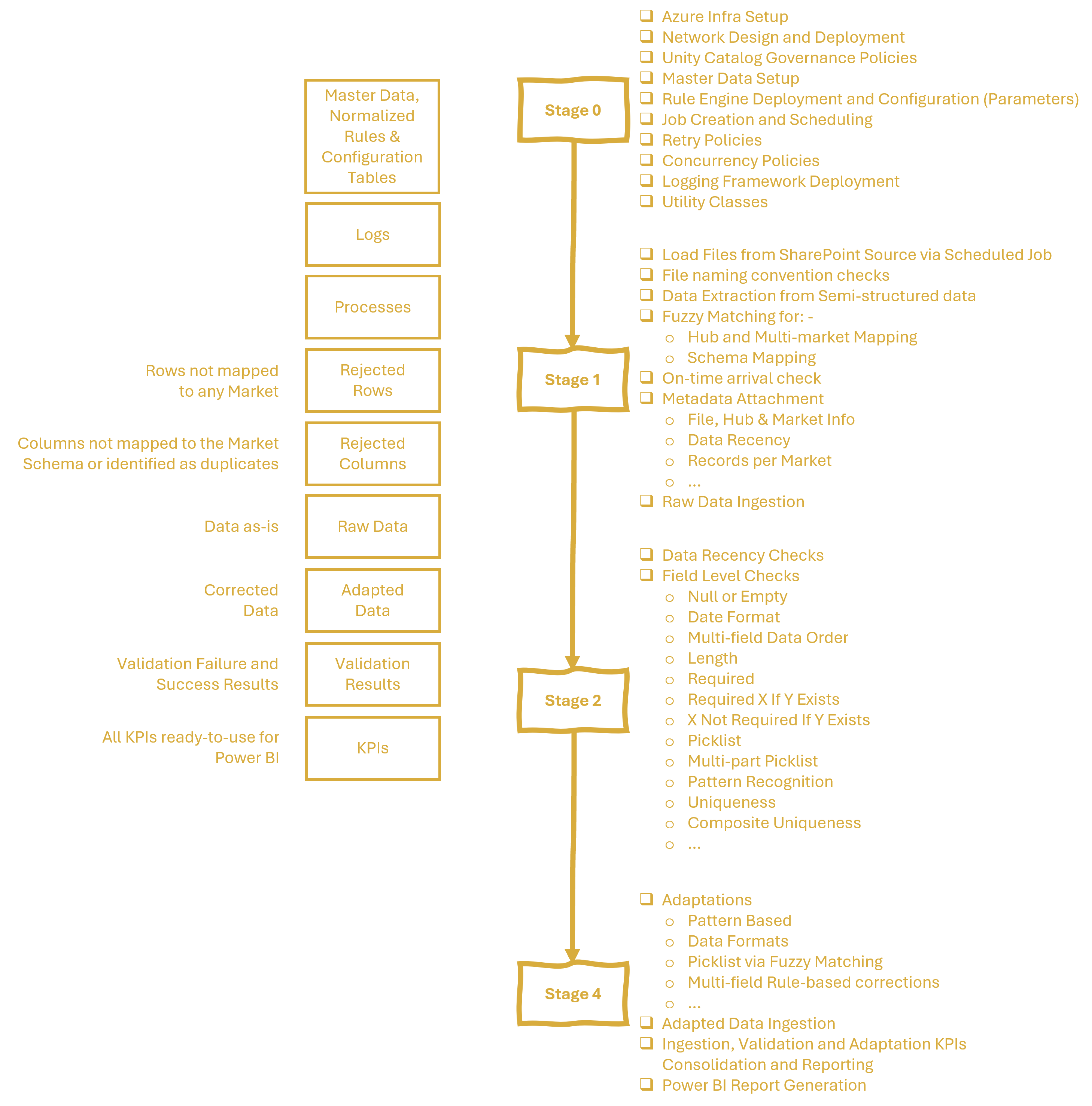
- Built a rule-driven automated data validation and adaptation platform on Azure to standardize, validate, and govern sales funnel data across markets.
- Implemented automated ingestion pipelines from SharePoint to Azure Databricks.
- Designed a configurable rule engine for file, schema, field, and cross-field validation.
- Built 21+ validation rule types with 500+ applied rule configurations.
- Implemented checks for timeliness, completeness, correctness, and uniqueness.
- Enabled automatic data correction, anomaly handling, and archival.
- Built a multi-stage validation and adaptation pipeline including schema mapping and fuzzy matching for market-specific structures, automated data normalization and corrections, and rejection tracking for invalid rows and columns.
- Delivered audit-ready governance using Delta Lake lineage and versioning.
- Created Power BI dashboards exposing 100+ data quality KPIs.
- Enabled configuration-based onboarding of new markets without code changes.
Section 03
Business Value
- Transformed fragmented regional submissions into a governed, automated, and auditable global sales data foundation.
- Established enterprise-grade data quality governance across markets.
- Enabled consistent global reporting for sales and marketing leadership.
- Reduced dependency on manual validation and operational support.
- Created a scalable foundation for future analytics and AI-driven sales insights.
80-90%
Less manual validation effort
Rule-driven automation substantially reduced the operational burden of weekly validation and adaptation.
500+
Automated rule applications
Configured rules enforced data quality consistently across incoming market submissions.
21+
Validation rule types
Coverage included schema, field-level, cross-field, and business validation checks.
100+
Data quality KPIs
Real-time metrics gave regional and central teams stronger visibility into data quality performance.
On-time
Reporting confidence improved
Leadership gained more reliable global sales funnel reporting across markets.
Faster
Decision-making improved
Sales and marketing leaders could act sooner because reporting was more dependable and timely.
- Manual validation and adaptation effort dropped significantly through rule-driven automation.
- Data quality enforcement became more consistent across schema, field, and business validations.
- Operational teams gained centralized visibility into quality performance across global markets.
- Leadership benefited from more reliable, on-time reporting and faster decision-making.
300+ sources analyzed across 60+ countries -> defensible impact validation
80% faster impact assessment (months -> <30 days)
AI-powered impact intelligence platform for global prize governance
Section 01
Problem Statement
- Global sustainability prize evaluators needed to verify and compare real-world impact across hundreds of global initiatives, but the data was highly fragmented and inconsistent.
- 120+ winners across 60+ countries and 200+ impact geographies had to be reviewed in one defensible evaluation cycle.
- Data maturity ranged from large enterprises to grassroots innovators, creating uneven evidence quality and inconsistent reporting depth.
- Evidence was spread across 300+ documents, reports, and submissions, with impact metrics varying across health, food, water, energy, and climate sectors.
- Many regions had limited infrastructure and unreliable reporting, while the organization still needed evidence-backed impact validation within 30 days.
- Designed a global impact evaluation framework across sectors and geographies.
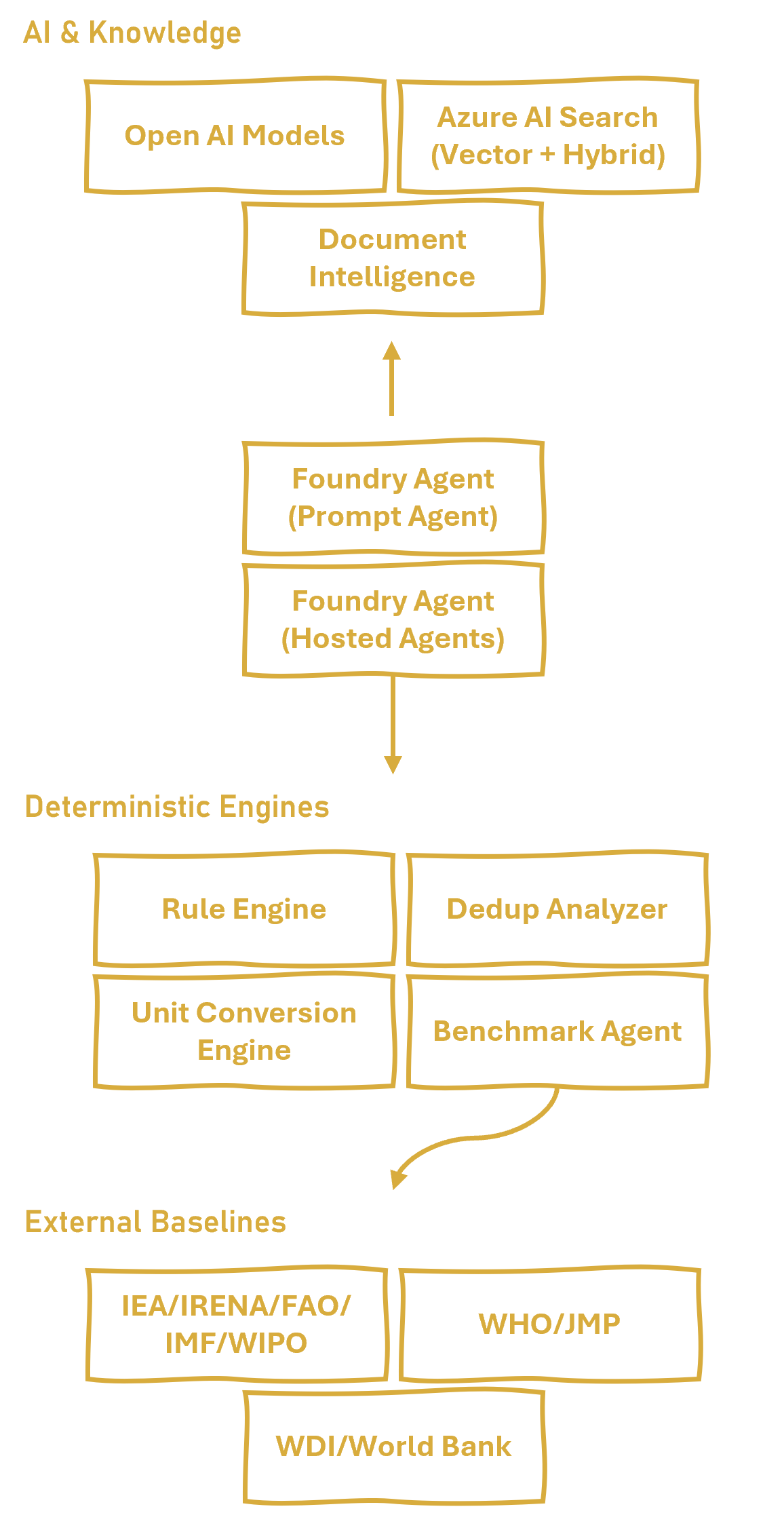
- Used GenAI and agentic AI to extract and structure evidence from 300+ documents and sources.
- Implemented AI search and knowledge retrieval using vector and hybrid search.
- Built deterministic engines for benchmarking, deduplication, rule validation, and unit normalization.
- Integrated global baseline datasets from the World Bank, WHO, FAO, IMF, and other institutions.
- Delivered an AI-accelerated, review-ready dashboarding platform for expert evaluators.
Section 03
Business Value
- Transformed fragmented submissions into auditable, defensible impact intelligence.
- Enabled objective comparison of innovations across sectors and geographies.
- Reduced dependency on manual research and subjective evaluation.
- Provided data-backed validation of sustainability outcomes.
- Created a repeatable impact measurement framework for future prize cycles.
10x
Faster impact assessment
Evidence extraction, retrieval, and benchmarking were accelerated with AI-assisted workflows.
300+
Sources structured
Fragmented submissions and external references were converted into usable impact intelligence.
30 Days
Evaluation timeline achieved
The platform supported a defensible review cycle within the required decision window.
Global
Credibility strengthened
Impact reporting became more defensible through data-backed validation across countries and sectors.
- Assessment turnaround improved dramatically through AI-assisted evidence extraction, retrieval, and benchmarking.
- Evaluator confidence increased because the underlying claims were grounded in traceable source evidence and normalized baselines.
- The organization gained a reusable platform pattern for future global prize cycles and broader sustainability intelligence workflows.
20,000+ telemetry updates processed per second
57M+ telemetry updates processed per hour
5,000+ distributed energy assets monitored in real time
Section 01
Problem Statement
- A US-based energy storage solutions provider operating in the CAISO energy market needed a scalable platform to process and analyze massive volumes of operational data from distributed energy assets.
- The estate included 5,000+ distributed assets such as inverters, cabinets, batteries, and power packs, along with 13,000+ sensors generating current, voltage, SOC, SOH, temperature, and irradiance data.
- The platform needed to handle more than 20,000 telemetry updates per second, or 57M+ updates per hour, while also combining operational telemetry with external signals such as CAISO market data and weather.
- Existing infrastructure lacked the ability to process high-frequency telemetry and generate actionable insights in near real time.
- Operational teams had limited visibility into asset health, performance, and market readiness, even though the business needed a high-throughput IIoT analytics platform for monitoring, performance analytics, and market-driven energy optimization.
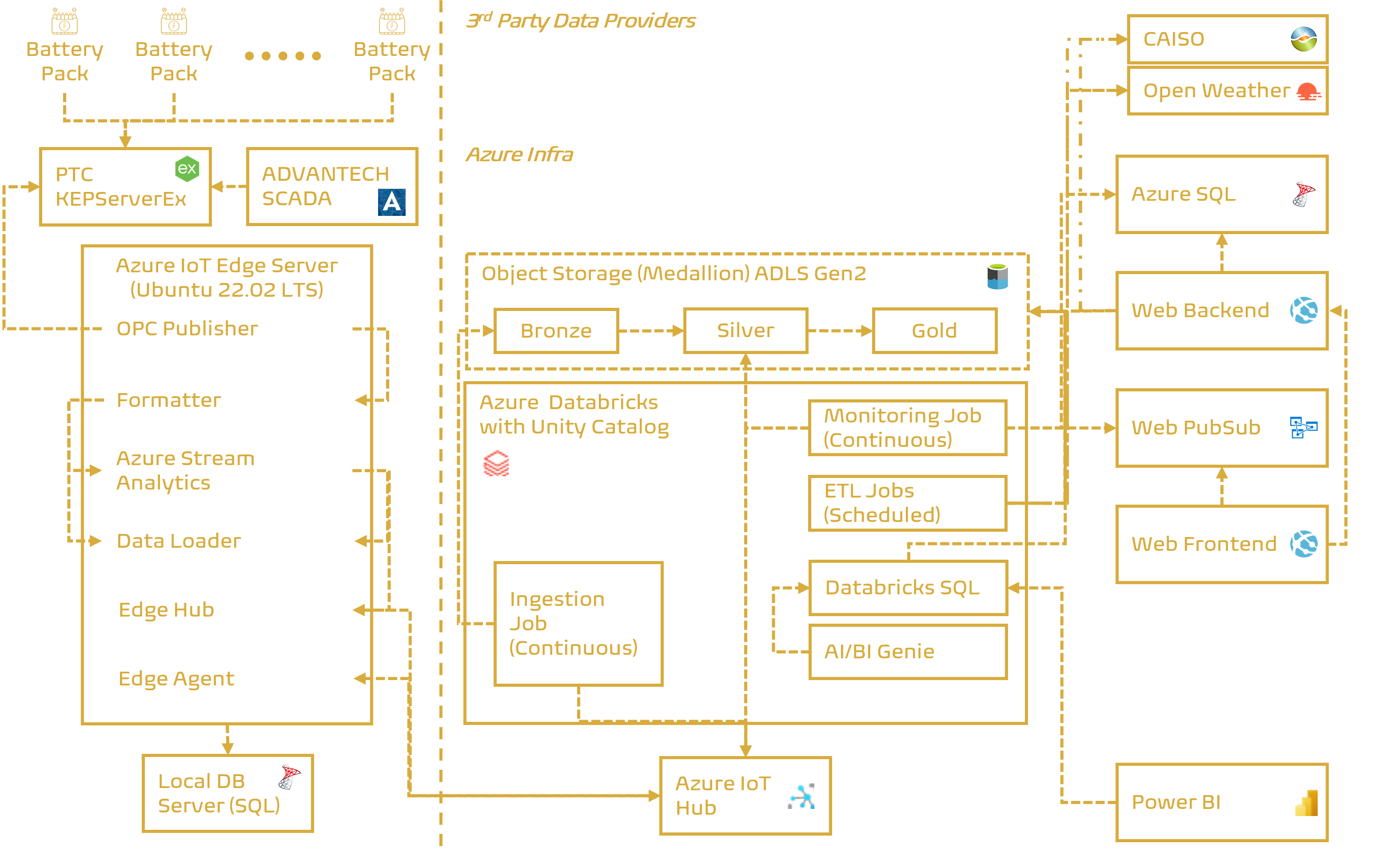
- Built a scalable IIoT and advanced analytics platform on Azure to ingest, process, and analyze high-frequency telemetry from distributed energy assets.
- Implemented edge ingestion using Azure IoT Edge and OPC publishers to collect telemetry from SCADA and Kepware servers.
- Designed a high-resolution telemetry pipeline using Azure Stream Analytics to process real-time sensor updates.
- Built a low-resolution pipeline via Azure IoT Hub for downstream ingestion and monitoring systems.
- Implemented streaming ingestion into a Delta Lake Medallion architecture (Bronze, Silver, Gold) using Azure Databricks.
- Enabled parallel ingestion pipelines for real-time and batch processing.
- Integrated external signals including CAISO market data and weather feeds.
- Implemented nightly ETL pipelines to generate operational KPIs and performance metrics.
- Delivered real-time monitoring and alerting using Azure SQL and automated notifications.
- Built a web-based analytics platform with Power BI dashboards.
- Enabled natural language data exploration through Databricks AI/BI Genie.
Section 03
Business Value
- Created a unified operational intelligence layer for distributed energy assets, enabling real-time monitoring and market-driven decision-making.
- Enabled high-throughput telemetry processing at industrial scale.
- Provided real-time operational visibility across thousands of distributed energy assets.
- Improved the company’s ability to participate in energy markets such as CAISO.
- Established a scalable foundation for advanced analytics, predictive maintenance, and AI-driven optimization.
20,000+
Telemetry updates per second
The platform processed high-frequency streaming data fast enough for operational monitoring and analytics.
57M+
Telemetry updates per hour
The ingestion and analytics pipeline handled continuous industrial-scale throughput across the asset base.
5,000+
Distributed assets monitored
Inverters, cabinets, batteries, and power packs were brought into a unified operational visibility layer.
13,000+
Sensors streaming continuously
Sensor telemetry across power, condition, and environmental variables was processed in near real time.
80+
Operational KPIs generated daily
Nightly ETL and downstream analytics created measurable performance indicators for the business.
Real-time
Monitoring and alerting enabled
The energy platform gained live alerts, analytics, and operational visibility across distributed assets.
- High-frequency telemetry processing became viable at operational scale across distributed energy infrastructure.
- Operational teams gained real-time visibility into asset health, performance, alerts, and market readiness.
- The platform created a stronger base for optimization, predictive maintenance, and AI-enabled energy analytics.
83% reduction in regression testing time (33 hours -> 6 hours)
5.5x increase in testing velocity
1,000+ automated executions validating zero data loss
Section 01
Problem Statement
- A US-based healthcare and life sciences company needed to ensure the reliability of its mission-critical order processing system, but regression testing was slow, manual, and error-prone.
- The regression suite covered 60 critical error scenarios, with 30 inbound and 30 outbound flows, and the full cycle required 33 hours of manual execution.
- Each scenario took roughly 20 minutes to execute and validate across complex data flows involving FTP and REST integrations.
- Orders were processed through multi-format files including Text, Excel, CSV, and JSON, with validation required across mainframe systems, databases, and UI layers.
- The process carried a high risk of missed defects, data inconsistencies, and delayed releases, creating the need for a reliable and scalable automated validation framework.
- Implemented a fully automated end-to-end order validation framework using Tricentis Tosca.
- Built end-to-end automated regression testing across inbound and outbound order flows.
- Automated file-to-database validation across multiple data formats.
- Implemented dynamic order ID generation and table-driven validations.
- Designed intelligent routing to support FTP ingestion for standard file formats and REST APIs for JSON-based orders.
- Enabled real-time database validation across PostgreSQL.
- Created template-based test models allowing one framework to execute 60 scenarios.
- Delivered a reusable, maintainable automation framework for continuous regression testing.
Section 03
Business Value
- Transformed manual regression testing into a scalable, automated quality assurance pipeline for mission-critical order processing.
- Improved release confidence and operational reliability.
- Eliminated manual validation effort across complex integration layers.
- Ensured data integrity across file ingestion, database processing, and UI validation.
- Created a repeatable automation framework for future regression cycles.
83%
Regression time reduced
The manual 33-hour regression cycle was reduced to roughly 6 hours through automation.
5.5x
Testing velocity increase
Teams gained faster and more repeatable execution across critical order scenarios.
100%
Automation coverage
Critical order processing scenarios were fully automated across inbound and outbound flows.
1,000+
Automated executions
Repeated automated validation cycles confirmed zero data loss across the framework.
15+
Critical mapping defects resolved
Automation exposed important data-mapping issues before they could affect production releases.
Zero
Post-release data incidents
The strengthened regression framework helped achieve high release confidence in production.
- Regression execution time dropped substantially while maintaining consistent validation across critical scenarios.
- Automation coverage improved reliability across inbound and outbound order-processing flows.
- Data integrity validation became more dependable across files, databases, and UI checkpoints.
- Release teams gained higher confidence with no post-release data incidents after implementation.